Wednesday, 15 March 2017

International Women’s Day Solidarity Walk in Reading #BeBoldForChange

Guest blog by Ruth Ng, Redlands WI, Berkshire Federation

On Wednesday 8th March, members from Redlands WI, Berkshire Federation as well as some friends and family, joined with local community groups and members of the public for a solidarity walk through the town centre to celebrate International Women’s Day.  The night before, some of us met under the guise of book group, but spent most of the evening putting together our WI banner and making placards to carry!  It was a lovely evening, with much hammering, lettering and laughter! 


We had decided to write some of the mandates that the WI has campaigned on over the years on our placards, such as ‘routine smear tests for cervical cancer (1964)’ and ‘adequate sentencing for rape (1988)’.  Reading through the mandates the WI has been involved in was an inspiring experience, and I felt very proud to belong to such an active organisation.


These feelings continued the next day as we met up ready for the walk, and with our placards and banner we felt like a ‘proper’ group!  Joining others from our local community on the walk was exciting, with both women, men and children from a variety of organisations including trade unions, Berkshire Women’s Aid, the Women’s Equality Party, the University of Reading Students’ Union and other local residents.  Meeting first in Forbury Gardens we then walked down the high street, with lots of onlookers coming out of the shops to see us, and some even grabbing cardboard boxes along the way to quickly make a sign to hold and join in.  I had brought my two children along (aged 10 and 4) and they both had placards to hold as well, thoroughly enjoying the atmosphere!  The messages being carried across the whole walk were all very different, but there was definitely a communal feeling, with us all having the same desire for equality.


The walk ended by the town hall, with speeches and songs.  One of the speakers specifically mentioned the WI’s involvement and how glad they were for our presence at the march, to which we all cheered loudly, of course!  The whole experience felt empowering, and it was a very positive and inclusive event, and left many of us feeling emotional, and proud.  I personally found it an inspiring experience, and I particularly enjoyed taking my children along, speaking with them about the WI, and about women’s rights and opportunities.  We are all eager for our next opportunity to take our banners out into the community and continue to spread the word about the amazing things that the WI has already, and continues, to achieve!


Monday, 6 March 2017

International Women's Day #BeBoldForChange

Guest blog by Mary Dorrell, Chairman of Norfolk Federation’s Public Affairs Committee and a member of Barford, Wramplingham and District WI.

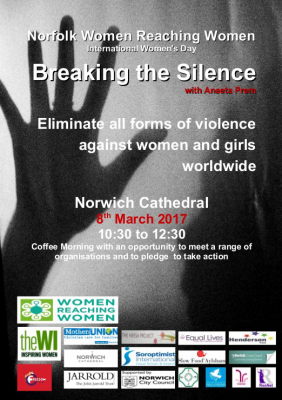
Norfolk Federation will be holding an International Women’s Day event in line with this year’s theme, #BeBoldForChange on Wednesday 8 March 10:30 am - 12:30 pm. Men, women and children of all ages, religions and cultures are welcome to come along to the event to be held in Norwich Cathedral.  

With three million women experiencing rape, domestic violence, forced marriage, sexual exploitation and other forms of violence and abuse each year in the UK alone, we must pledge to #BeBoldForChange. The NFWI’s campaign WomenReaching Women was launched in 2008 as a three year educational project, focussing on world poverty, climate change and gender inequality. The campaign continued to flourish in Norfolk; a coalition of women’s groups and organisations was set up, including Mother’s Union and the Women’s Equality Party. An annual event on International Women’s Day also started, with 2016’s event focussing on connecting the different lives and cultures of women living in Norfolk.

This year’s event focuses on achieving gender equality and empowering women and girls to be bold for change. In November 2016 Norwich City Council asked us to help with the Norfolk-wide #IWalkedAway campaign, a 10 foot tall White Ribbon, which symbolises the global effort of men working to end male violence against women, was sewn by the WI and over 20 other community groups. The White Ribbon will be at the event in the Cathedral, which will bring together a variety of groups to highlight the work already being done and to pledge for future action.

The keynote address will be given by Aneeta Prem founder of the Freedom Charity, which aims to raise awareness and prevent child abuse affecting girls in the UK, on issues such as forced marriage and female genital mutilation. Other guests include: The Lord Mayor of Norwich, Councillor Marion Maxwell and Lorne Green, Norfolk Police and Crime Commissioner for Norfolk.  

We will come together on International Women’s Day to highlight our concerns for women and girls facing violence and pledge to #BeBoldForChange.


If you would like more information on the event please contact Louise Casson: fedsec@norfolkwi.org.uk 

Friday, 24 February 2017

Resolution selection results announcement

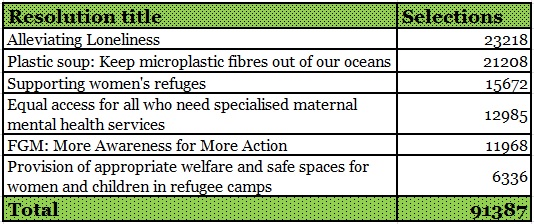
Between November and February, every WI member had the chance to have their say about the resolution they wished to go forward to the Annual Meeting in Liverpool on 7th June. The results of the 2017 resolution shortlist selection process are:


As the two most popular resolutions were only just over 2000 selections apart, the NFWI Board of Trustees decided to put both forward to the Annual Meeting. This means that the following resolutions will be considered at the Annual Meeting.

Alleviating loneliness
This meeting calls on every WI and the NFWI to work alongside health and social care providers and their local community to raise awareness of the causes and impacts of loneliness, thus ensuring better identification of lonely people in order to be able to offer them the appropriate assistance and support.

Plastic Soup: Keep microplastic fibres out of our ocean
Microplastic fibres are shed from synthetic clothing with every wash and are the main contributors to microplastic contamination of the oceans. The NFWI calls on Government and industry to research and develop innovative solutions to this problem in order to stop the accumulation of microplastic fibres in our oceans.

What happens next?
Members now have the opportunity to learn more about the issues, and to discuss the two resolutions in their WIs before deciding how they wish their delegate to vote at the AM.

How does my WI cast our vote?
All WIs get one vote for each resolution. This means your WI shouldn’t vote for one resolution over the other, but should vote for or against each one independently. If both resolutions are passed at the AM, the NFWI will campaign on both issues.

Your WI can also choose to give discretion to your delegate to decide how to vote after hearing the presentations and debate at the annual meeting.

Only votes cast for and against the resolutions will be counted, in accordance with the voting procedure set out in the NFWI Memorandum and Articles of Association. Abstaining means that a delegate would not cast a vote, and therefore this abstention would not be counted.

What resources are available to support WI discussions? 
To support members to get involved the Public Affairs team has produced a range of resources.

Alleviating loneliness


Plastic Soup: Keep microplastic fibres out of our oceans


Other resources available include:

  • a guide to holding a resolutions meeting; 
  • a frequently asked questions document explaining the process. 

All these resources are available to download from the website.

The Public Affairs Team will also be holding social media Q&A sessions in the run up to the AM to answer member questions. Dates and times for these sessions will be published on the website shortly and promoted on Twitter @womensinstitute and Facebook.

I’m passionate about one of the resolutions that was unsuccessful, can my WI work on this issue too?
While the resolutions going forward to the AM have the potential to become flagship national WI campaigns, there are many other ways WIs and members can work on other issues at a local or Federation level.

The WI has worked on violence against women for many years, and there are a number of existing mandates that allow members to work on these issues in their own communities. The NFWI regularly promotes opportunities for members to get involved in campaigning activity on this issue. Most recently, the WI has supported the IC Change campaign to push the government to ratify the Istanbul Convention on violence against women and girls.

Members who would like to work on issues related to violence against women could raise awareness of local, national and international gender issues during International Women’s Day on 8 March or attend the Million Women Rise March. NFWI Wales is also promoting the Not in my Name campaign to engage men in pledging their support in ending violence against women.

Similarly, the WI’s longstanding More Midwives campaign has called for action to ensure that women get the right support before, during and after birth, most recently with the launch of our Support Overdue 2017 report. Our report found that nearly 20% of women are not seeing a midwife as often as they needed to after birth, and half of those women told us they wanted to discuss their mental or emotional wellbeing but were not able to. Members can support the campaign by writing to their MP or AM asking them to end the midwife shortage.

You could also consider approaching your Federation to put forward a resolution at Federation-level. To find out how to go about this, please contact your Federation direct.

Wednesday, 22 February 2017

The WI Walks the Trans Pennine Trail

By guest blogger Louise Checkley, member of N1WI

WI Walks is the walking group from N1WI, Middlesex federation. The group is run by Anna, Helena and myself. We have an active Twitter and Facebook account promoting WI walks around the country, inspiring women to get active.


2015 was the year of the WI Centenary. To celebrate, WI Walks walked the whole length of the Thames from source to Thames barrier, a total of 184 miles in 8 days. We raised £700 for our N1WI centenary bench appeal and local charities. We carried the WI centenary celebration baton and met a wealth of WI talent along the route.


This year Denman needs us!

After watching Jo Brand walk from Hull to Liverpool for Sport Relief last year we were inspired to take on 185 miles of the Trans Pennine Trail.

We will be walking from Liverpool to Hull, learning from Jo Brand that walking into head wind is no fun! We start walking Saturday 27th May 2017 finishing Sunday 4th June 2017, just before the National AGM on the 7th June in Liverpool.

We will be raising funds for the Saving Denman Appeal and meeting lots of WI members along the way. Donations are welcome via the JustGiving page.

If you would like to join us on our trek to save Denman see the itinerary below. 


You are more than welcome to join us for the total 185 miles, 1 day, a morning or afternoon or meet us for lunch, we are always grateful for cake…! If you can’t walk with us follow our story via our Twitter and Facebook pages. 

You can contact us via email: thewiwalks@gmail.com or via Facebook: https://www.facebook.com/thewomensinstitutewalks/


Tuesday, 24 January 2017

Have your say on the resolutions shortlist

Mary Dorrell is Chairman of Norfolk Federation’s Public Affairs Committee and a member of Barford, Wramplingham and District WI. Here she explains why it is important for WI members to have their say on this year’s resolution shortlist.

To access the shortlist, background notes, PowerPoint presentations and quizzes visit the resolutions page of the WI website.

The WI has over 100 years of campaigning to its credit. We are not party-political you see, but we do take on politicians to get things done.

In 1930 we were campaigning to get an improved and adequate water supply into all rural areas in England and Wales. We have campaigned for Equal Pay for women since 1943, and in 1953 we were successful in changing arrangements for children in hospital so that parents were able to visit.

Our ‘No More Violence Against Women’ mandate dates from 1975, and this is a campaign we are still working on today. In Norfolk we worked with other community groups to create a giant white ribbon totem for International Day Against Violence in support of the White Ribbon campaign.


We also have many successful environmental campaigns. In 1927 we spoke out against the pollution of our seas from waste oil thrown over from ships, and the famous 1954 resolution on litter led to the creation of the Keep Britain Tidy campaign.  

More recently our SOS Honey Bee campaign won The Third Sector Excellence Charity Partnership Award in 2014 for our partnership with Friends of the Earth. This campaign successfully pushed the government to launch the National Pollinator Strategy which sets out a plan to support bees and other pollinators.

Norfolk has always played a proud part in the resolutions process. Hellesdon WI put forward a successful resolution in 1964 to campaign for a ban on smoking in public places and in 2008 the Care not Custody campaign was borne out of a resolution originally devised by Brundall WI, and was successfully proposed by Norfolk Federation.

These mandates form the basis of campaigns supported by 220,000 WI members in 6,300 WIs across England, Wales and the Islands. All WI mandates come from ordinary WI members like you, working together in their own WIs.

Many WIs were hard at work over the summer, conducting research and discussions to put forward their own ideas for resolutions. In September the 85 resolutions submitted were considered by representatives from WI Federations to agree the shortlisted six you saw in the November/December edition of WI Life.

Every WI member has the chance to cast their selection for the resolution they support the most. Now it’s your turn!

Tuesday, 17 January 2017

Guest blog from WI member Nicola Hatch Lighterness about the new WI report 'Support Overdue (2017)'

WI member, baby blogger, and new mum Nicola Hatch Lighterness, welcomes the publication of the WI’s new report into women’s experiences of maternity care and shares her own story showing why we need more midwives now.


In 2012, WI members voted to start a campaign to push the Government for more midwives. We had heard horror stories about the care of our friends, our sisters, our daughters; we started to suspect that we weren’t alone in our struggles with postnatal depression or breastfeeding; those of working as midwives or support staff had begun to suffer from extreme burn-out. Something needed to change and as the largest women’s organisation in the UK, if we didn't speak up who would?

I joined the WI in 2014 when I was trying to have a baby. By that time the WI had already published a report examining the experiences of women giving birth and over 30,000 members had participated in the campaign. We were making progress. The NHS, citing our report, commissioned a major review of maternity services and the Secretary of State for Health admitted that we needed more midwives. The National Institute for Health and Care Excellence (NICE) published its first ever safe staffing guidance for maternity settings in 2015, which the WI contributed evidence to and warmly welcomed.

But we are still missing 3,500 midwives in England, a shortage I experienced first-hand. The WI is today publishing a new report – Support Overdue (2017) – which sadly shows that my experience is not unique. The report found that as many as 50% of women will give birth in labour wards today that are short-staffed, leaving many women alone while they are in labour or unable to receive essential care like pain relief.

Being pregnant is a joyful time for many women, but it can also leave us feeling vulnerable. Midwives are often our lifeline, the person that’s standing in our corner, making sure everything is ok and reassuring us when things get tough. So many mums I know speak glowingly of how lovely their midwives were. So what is going wrong?

Well, the WI found that a big part of the problem is fragmented care. With the birth-rate holding steady, and midwife numbers dropping, fewer midwives must care for more women. Midwives are so pressed for time that they are often pulled out of community care and into labour wards. This means that women can see lots of different midwives during their care and never have a chance to build a relationship with any of them!

Unfortunately I know all about this fragmented care, although on paper I was one of the lucky ones. In my local area, it is common practice to see the same midwife all throughout your pregnancy. For someone like me, who suffers from anxiety, this was excellent. I got to know my midwife and she got to know me. This meant that when she had to explain to me the possible complications of the low levels of Papp A that my pregnancy suffered from, she was able to do so in a way that didn't send me into a complete panic! Any test results that she had, she would give me in a reassuring way, and when my blood pressure started to creep up towards the end of my pregnancy and there was the potential for pre-eclampsia, I knew I was in safe hands.

By once my son was born, my care started to break down. Due to an admin error, I had been attending my antenatal appointments in the next town. This was corrected after the birth. All very well and good, except my new midwives, whilst very caring, didn't know me in the same way as my old midwife did.

I saw multiple midwives in my 28 day postnatal care period. I was unable to build a relationship with any of them and they didn't understand my anxiety. They couldn't understand why I would break down in tears during appointments.  They didn't understand why I struggled on with breastfeeding despite hating it, despite it making me feel more depressed. They didn't understand- and didn't anticipate- my constant worry.

All of this was made even worse by the fact that the midwives were too busy to come to my home more than once. I had to walk 30 minutes each way for the rest of my postnatal appointments. For someone with anxiety issues- like me- this was a daunting prospect. In fact, as many as 20% of new mums suffer from some kind of postnatal depression and we’re supposed to be seen during this critical time as often as we need to be. The appointments are also supposed to be at our home or in a location convenient to us. But for me- and all the other new mums in my area- this didn't happen because the midwives, wonderful though they were, didn't have the time.

Travelling to these appointments was difficult for me because I felt like a nervous wreck. I look back at this time now and those feelings of being overwhelmed are enough to stop me from having another child. This is why the WI is recommending that as a bare minimum standard all new mums receive midwife visits in their home at least twice postnatally. This would have helped me so much. Midwives want to do it, but there are not enough of them to go around.

I know we’re fond of saying ‘all’s well that ends well’ and for me it did end well. I got through my difficult postnatal time. But the WI thinks that just ‘getting through’ is not good enough anymore. Nearly three quarters of a million women will use the maternity service every year. These women and their families rely on midwives to be there when it matters. Policy makers need to act now and end the shortage of midwives.

To read Nicola’s baby blog visit: http://allthingsspliced.co.uk/

To learn more about the NFWI’s campaign for More Midwives visit: https://www.thewi.org.uk/campaigns/current-campaigns-and-initiatives/more-midwives


Nicola and other members of Brentwood Belles WI


WI research shows more midwives still needed

Today the WI and NCT have launched our second report into maternity services. Now we need your help to make sure the Government hears our call for more midwives.

The report is the next stage for the More Midwives campaign, which was launched in 2012 after a resolution calling for an end to the shortage of midwives, was passed at the WI Annual Meeting.

While women were generally positive about the care they experienced, we found that the shortage of midwives continues to impact mothers, babies and their families. Despite four years having passed since our first report, our research suggests that little progress has been made in that time.

Shockingly, half of women told us that they had experienced at least one ‘red-flag’ event during childbirth. A red-flag event is a sign that there may not be enough midwives available to give women and babies the care they need. This could mean having to wait more than 30 minutes to get pain relief, or not receiving one-to-one care during labour.


We also found that postnatal care is still failing far too many women. Almost one in five women (18%) did not see a midwife as often as they needed to postnatally. This resulted in delayed diagnoses of health problems at a critical time for mothers and babies.


Almost a third of these women were forced to turn to other parts of the NHS like GPs, walk-in centres or even A&E to get the help they needed. This is simply not sustainable when our NHS services are under such huge pressure.


The vast majority of women (88%) told us that they did not know their midwife before they went into labour or gave birth. This is the same result as we found in our first research report, and suggests that continuity of care remains an aspiration, not a reality.


Marylyn Haines Evans, Public Affairs Chair of the NFWI said:

“The findings from this report show that chronic midwife shortages (an estimated 3,500 in England alone) continue to undermine the delivery of high quality care for women and their families.  Half of the women we spoke to reported red-flag events during their care, suggesting that staffing levels are at crisis point.

“Women have told us that midwives are working hard to do the very best that they can, but that there are simply not enough of them to go around. We are calling on the Government and the NHS to end this chronic midwife shortage immediately and take the necessary steps to ensure midwives are supported to remain in the profession.”

It is clear that we need urgent action to address the shortage of midwives. We now need WI members to write to their MPs and AMs and encourage them to raise the issue with the Government in Westminster and Wales. You can download a template letter here.