Today's guest post is from Anna Bradley-Dorman, a WI member from Huntingdon and Peterborough Federation
In September I was lucky enough to attend the NFWIs ‘Caring Challenge Conference’ with a fellow trustee, Phyllis Brookes, at which we heard about the challenge of dealing with an increasingly aging population and the growing numbers of people living with dementia. I don’t know anyone who doesn’t know someone who is affected by dementia. We often hear about the devastating effects of dementia but forget that these people are part of our community and it is up to all of us to ensure that they can continue to be a part of it.
My personal association with dementia started nearly forty years ago when my beloved grandma turned into a bad tempered, violent woman. Back then no-one could explain it to me. I just thought it was what happened when you got old – but it isn’t. Not all old people are going to get dementia and not all people who have dementia are old. This is just one of the many misconceptions surrounding this disease that needs to be rectified. Dementia needs to be talked about, not swept under the carpet. We need to become a Dementia Friendly Society – this includes individuals, organisations and government. Individuals can become Dementia Friends, organisations can become Dementia Friendly and areas can become Dementia Friendly Communities.
What is a ‘Dementia Friend’ I hear you say? Back in March 2012 the Prime Minister set out his challenge on dementia and commitment to deliver improvements in care and research by 2015. The National Federation of Women’s Institutes (NFWI) signed up to be part of the Prime Minister's challenge and joined a Dementia Friendly Communities Group which has been tasked with finding out what can be done to make our communities more dementia friendly. To help build dementia friendly communities, the NFWI is backing the Dementia Friends initiative, helping to create a network of a million dementia friends by 2015. The intention is to build public awareness of dementia and the small things that people can do that can make a difference to people living with dementia, providing a helping hand to enable them to go about their daily lives and feel included in the local community.
The other main focus of the conference was the effect our aging population is having on carers. More and more of us will have to care for a loved one in the future. Many carers are left to cope with little support. Quite often the focus is, naturally, on the person living with dementia but we forget that the carer needs support too. Carers need to be provided with necessary help and support early on – financial, social and medical. They are often faced with trying to navigate through the baffling, uncoordinated realm of social and health care systems with little or no help. They frequently feel that their opinions are not valid when they are the person who knows their relative the best. I have witnessed first-hand the difficulties carers face as I watched both my mother-in-law and father care for spouses with dementia.
So we went back to our federation armed with statistics, personal stories and information. It was obvious we needed to do something but what? We realised that we could talk about it until we were blue in the face but we really wanted our response to be practical. We could blind our members with science and facts but apart from increasing awareness what would it achieve? Eventually we came up with a plan. I am fortunate to work as an administrator for a local community development charity that works with many different organisations. Three organisations came to mind and were invited to come along to our Federation Centre on the 10 May 2014. At this session, in direct response to the ‘Caring Challenge’, the audience heard from speakers, each of whom were tackling this issue head-on.
James Nicol is a Dementia Champion who has received training and volunteered to recruit people to become Dementia Friends. James is passionate about this project and gave an interactive presentation after which several members signed up to become a ‘Dementia Friend’. He spoke about how Dementia Friends is giving people an understanding of dementia difference to people living with dementia – from helping someone find the right bus to spreading the word about the disease to ensure those living locally are supported and can live well with dementia.
Linda Collumbell from Carers Trust Cambridgeshire described an innovative pilot scheme called ‘The Better Health Network’ which has been designed to improve the support provided to elderly people and those with long term conditions, by co-ordinating the services being delivered by charities and voluntary organisations. The scheme offers a one-off assessment which is then used to identify the relevant support. Key to the pilot is the close coordination of Social Services and NHS services with those provided by charities and voluntary groups.
Lauren Stonebridge from The Great Fen and Barbara Cobb from Ramsey Rural Museum spoke about a joint project to deliver reminiscence sessions using memory boxes. Reminiscing can be a useful tool for people with memory problems to help improve their self-esteem, personal identity and increase their socialisation. The memory boxes cover many different life topics and contain a variety of objects which are used to trigger memories and generate discussion.
At the end of the morning the audience went home with practical things they could do, a greater understanding and useful information. At the moment we can’t prevent this disease but there are ways of making life a little easier for those living with dementia and the people who care for them.
Find out how to become a Dementia Friend here
A look behind the scenes at 104 New Kings Road - the National Federation of Women's Institutes (NFWI) head office
Friday, 16 May 2014
Monday, 28 April 2014
A Bee in My Bonnet!
The latest bee blog from Martha Kearney. Follow the seasons and gain a unique insight into the world of beekeeping with Martha Kearney, BBC journalist and beekeeping enthusiast. Martha has raised awareness of the honeybee's plight, notably through the BBC 4 series “The Wonder of Bees”.
I was asked to give a speech recently in my new role as President of the Classical Association and decided to pick the theme of beekeeping in antiquity with the title Mellis Caelestia Dona, the heavenly gift of honey. That comes from the most famous bee poem of all time - Virgil's Fourth Georgic. As well as being beautiful verse, this also contains remarkably good beekeeping advice including the best plants to have nearby, to use smoke to calm the bees and the need for a source of water. He does get a bit nutty about producing bees from the carcass of a dead ox which was known as Bugonia in ancient times. If you've ever looked at a golden syrup tin you'll get the idea. They used the image of a dead lion from a Biblical story. Nonsense of course as honey bees hate carrion.
Bees were popular from the most ancient of times. There are pictures of beekeepers in Egyptian temples from four and a half thousand years ago.
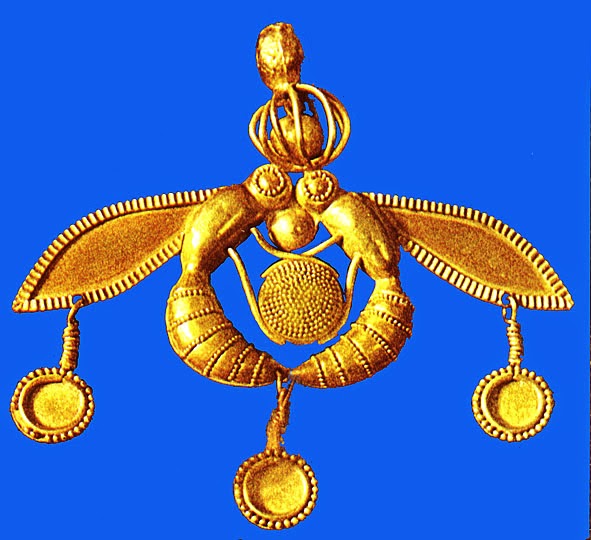
And take a look at this beautiful brooch from the Minoan civilisation on Crete.
Virgil was only one of several ancient authors who wrote on bees - Homer, Hesiod, Aristotle, Cato, Pliny, Columella and Varro for whom the nasty varroa mite is named. I kept my other half informed about my research and told him one day that I had found a new word - mellarius which means beekeeping slave. "I already know the meaning of that word" he said drily.
You can see us both in action in episode 3 of The Wonder of Bees on BBC4 at 8pm on Monday night. The earlier ones are on the iplayer. This time we are extracting honey in a very much Don't Try This at Home way. I also meet a natural beekeeper who lets her bees swarm and doesn't use chemicals to treat for varroa. You can find more information here.
But many beekeepers will disagree with that approach. There is extensive information on the British Beekeepers association site here.
They also run a scheme called Adopt a Beehive for people who want to support bees with keeping them themselves.
If you have any thoughts on how the government can help honeybees and other pollinating insects, then there is still time to contribute to the consultation on the National Pollinator Strategy which ends on May 2nd. For more information on how the NFWI and WI members are getting involved in the campaign, and for details on how you can help, please visit the website.
If you have any thoughts on my blog or bees, do get in touch via Twitter @MarthaKearney
To read more from Martha, please visit her bee blog on the NFWI website.
Tuesday, 15 April 2014
A Bee in My Bonnet!
The latest bee blog from Martha Kearney. Follow the seasons and gain a unique insight into the world of beekeeping with Martha Kearney, BBC journalist and beekeeping enthusiast. Martha has raised awareness of the honeybee's plight, notably through the BBC 4 series “The Wonder of Bees”.
My hives have now truly become Bee List Celebrities. This weekend the society magazine Tatler came to photograph them for their feature called Pet of the Month.
I am not too sure about the lineage of my bees but Apis Mellifera does have a noble heritage. The Barberini family in Rome had a bee as their emblem. Napoleon picked one as the symbol of his grandiose coronation.
The reason Tatler was interested is because my TV series The Wonder of Bees begins on Monday April 14th, the first of four about the ups and downs of beekeeping in the course of a year. I thought we were doomed from the outset as it was so cold last year.
Under the expert eyes of John Everett, a master beekeeper from Norfolk, I was taught many new aspects of beekeeping from spotting disease to seeing a baby bee being born.
See video clip here
I also became much better at spotting the queen but I still find it very difficult to see eggs which are like tiny white threads in the hexagonal cells. John also showed me a way of controlling swarms but I'm not sure I am ready to follow suit. It involves clipping the queen's wings.
See video clip here
So did we succeed against all the problems of the weather and produce a jar of wildflower honey? Stay tuned......
You can find more information on the Facebook page The Wonder of Bees or on Twitter @wonderofbees
For related newspaper coverage see:
The Independent; To bee or not to bee
The Telegraph; Archbishop of Canterbury - I talked to the bees
The Financial Times; Martha Kearney's bee list celebrities
Martha Kearney's full Bee Blog is available to view on the NFWI website here.
Tuesday, 1 April 2014
"Only one of my five children has ever had a banana"
Abbie Traylerr-Smith/Oxfam
“Since the snows melted last month Yazmik Josephyan has made a daily two hour trek into the mountains to go foraging for Mandak.”
In 2012, the NFWI launched a programme of work on food security, the WI Great Food Debate, with the aim of opening up a public conversation on how to feed an ever increasing population with finite land and resources. Since that time, federations and WIs up and down the country have held debates exploring the issue and investigating solutions. This year, we at Norfolk Federation decided to base our annual International Women's Day celebration on the theme of ‘Shared Earth, Common Ground’ to scrutinise some of these issues further. Norfolk is the home to many experts on this topic, so we were not short of specialist input, and we had plenty to talk about. Were the answers Global or Local? Organic or GM? We needed a conversation.
Wendy Harwood of The John Innes Centre (JIC), an independent international centre of excellence in plant science and microbiology, started the debate. She questioned whether, in light of technological advances in genetic modification (GM), we should be reconsidering the way we approach the production and regulation of GM foods. Peter Melchett, Policy Director at the Soil Association and Norfolk organic farmer, made it clear to us what our choices are as individuals in a world that already has enough food to feed a growing population, but not always in the right place. He explained that we all need to change our diet, and reduce the level of empty calories and cheap, intensively reared meat that we all consume. He highlighted the benefits of organic farming that include the potential of a lower carbon footprint and a closed system in which farmers, particularly in the less developed world, are not reliant on outside forces to produce their food.
We continued the conversation in workshop sessions, which allowed us to explore a number of different perspectives. Should we eat seasonally and avoid vegetables being flown in from Kenya, freeing Kenyan women to grow food for their own families? Or do Kenyan women want jobs to earn money, send their children to school, move to the towns and shop at their convenience in the local supermarket? It was good to hear the debate between Norfolk organic gardeners and those who had travelled to East Africa and had spoken to the women in question. Another discussion was the management of overseas aid. Was it right that money for food aid given to Egypt may have been used to irrigate the desert so that we in the western world could buy new potatoes at Christmas? Once again, global food issues are inextricably linked with local consumption.
Alejandro Chaskielberg/Oxfam
Oxfam beneficiary Tioko Korima, 20, waters the vegetables she is growing in her kitchen garden
Later Martyn Davey from Easton & Otley College explained why “Horticulture Matters” and Grant Habershon, Project Manager with Norwich Food Bank, described how many families in Norwich end up going hungry when a sudden crisis such as bereavement, redundancy or illness, leaves them unable to feed themselves or their families. Benefit delay was highlighted as a particular problem, and even families who are coping well can find themselves struggling in August, when free school meals are not available. Food banks are increasingly plugging the gaps and Norwich Food Bank is no exception; it expects to feed more than 7,000 people this year and launched its first Lunch Club in August 2013. There was an opportunity to catch up on a Channel 4 documentary featuring some of the children it has helped.
For our final panel session, the speakers were joined by Christine Hill from the NFU and Young Farmers Club, and Simon Wright MP. The discussion was wide ranging, but it proved hard to come up with conclusive answers. Could GM co-exist with organic principles? Should the debate be so polarised? The rise in obesity goes hand in hand with economic development, but what causes famine? Is it the force of nature, or economic, or political? The management of soil and water is critical, but not always under the full control of the local farmers. The conversation is clearly a complicated one, and this was reflected in the ensuing discussion. As one member said, “Action? The problem is where to start. Probably reviewing the compost and looking at the politics behind issues of distribution though we'll see lots of food for thought”.
But it did become clear that many participants left with ideas that they felt they could pursue locally. The last words go to them:
“I thought the day was very good, interesting and thought provoking, I have never been moved to tears before but those two children on the food bank video started my tears and I shall now try to encourage my WI and others to collect and help in the Swaffham area.”
In fact many of those who thought they would take action wanted to “spread the word regarding excellent work of food banks and Lunch Clubs”.
In general, several members said that they “Will share with our local WI” and “Hopefully my WI will become more informed and then action to follow. Perhaps set up our own food collection point for the local food bank”.
Others said they would “find out more about the debate concerning organic and GM”… “Eat less meat” … “Grow more of my own food” … “Will waste less, compost more and consider an allotment. Will spread the word” … “Take more interest in sustainable food, seasonal food and the wonder of nature's bounty.”
Are the answers Global or Local? Organic or GM? We needed to start the conversation.
Supplied by Norwich City Council
This post has been written by Mary Dorrell from Barford, Wramplingham & District WI in Norfolk Federation. Mary sits on the NFWI Public Affairs Committee as a Federation Representative.
“Since the snows melted last month Yazmik Josephyan has made a daily two hour trek into the mountains to go foraging for Mandak.”
In 2012, the NFWI launched a programme of work on food security, the WI Great Food Debate, with the aim of opening up a public conversation on how to feed an ever increasing population with finite land and resources. Since that time, federations and WIs up and down the country have held debates exploring the issue and investigating solutions. This year, we at Norfolk Federation decided to base our annual International Women's Day celebration on the theme of ‘Shared Earth, Common Ground’ to scrutinise some of these issues further. Norfolk is the home to many experts on this topic, so we were not short of specialist input, and we had plenty to talk about. Were the answers Global or Local? Organic or GM? We needed a conversation.
Wendy Harwood of The John Innes Centre (JIC), an independent international centre of excellence in plant science and microbiology, started the debate. She questioned whether, in light of technological advances in genetic modification (GM), we should be reconsidering the way we approach the production and regulation of GM foods. Peter Melchett, Policy Director at the Soil Association and Norfolk organic farmer, made it clear to us what our choices are as individuals in a world that already has enough food to feed a growing population, but not always in the right place. He explained that we all need to change our diet, and reduce the level of empty calories and cheap, intensively reared meat that we all consume. He highlighted the benefits of organic farming that include the potential of a lower carbon footprint and a closed system in which farmers, particularly in the less developed world, are not reliant on outside forces to produce their food.
We continued the conversation in workshop sessions, which allowed us to explore a number of different perspectives. Should we eat seasonally and avoid vegetables being flown in from Kenya, freeing Kenyan women to grow food for their own families? Or do Kenyan women want jobs to earn money, send their children to school, move to the towns and shop at their convenience in the local supermarket? It was good to hear the debate between Norfolk organic gardeners and those who had travelled to East Africa and had spoken to the women in question. Another discussion was the management of overseas aid. Was it right that money for food aid given to Egypt may have been used to irrigate the desert so that we in the western world could buy new potatoes at Christmas? Once again, global food issues are inextricably linked with local consumption.
Alejandro Chaskielberg/Oxfam
Oxfam beneficiary Tioko Korima, 20, waters the vegetables she is growing in her kitchen garden
Later Martyn Davey from Easton & Otley College explained why “Horticulture Matters” and Grant Habershon, Project Manager with Norwich Food Bank, described how many families in Norwich end up going hungry when a sudden crisis such as bereavement, redundancy or illness, leaves them unable to feed themselves or their families. Benefit delay was highlighted as a particular problem, and even families who are coping well can find themselves struggling in August, when free school meals are not available. Food banks are increasingly plugging the gaps and Norwich Food Bank is no exception; it expects to feed more than 7,000 people this year and launched its first Lunch Club in August 2013. There was an opportunity to catch up on a Channel 4 documentary featuring some of the children it has helped.
For our final panel session, the speakers were joined by Christine Hill from the NFU and Young Farmers Club, and Simon Wright MP. The discussion was wide ranging, but it proved hard to come up with conclusive answers. Could GM co-exist with organic principles? Should the debate be so polarised? The rise in obesity goes hand in hand with economic development, but what causes famine? Is it the force of nature, or economic, or political? The management of soil and water is critical, but not always under the full control of the local farmers. The conversation is clearly a complicated one, and this was reflected in the ensuing discussion. As one member said, “Action? The problem is where to start. Probably reviewing the compost and looking at the politics behind issues of distribution though we'll see lots of food for thought”.
But it did become clear that many participants left with ideas that they felt they could pursue locally. The last words go to them:
“I thought the day was very good, interesting and thought provoking, I have never been moved to tears before but those two children on the food bank video started my tears and I shall now try to encourage my WI and others to collect and help in the Swaffham area.”
In fact many of those who thought they would take action wanted to “spread the word regarding excellent work of food banks and Lunch Clubs”.
In general, several members said that they “Will share with our local WI” and “Hopefully my WI will become more informed and then action to follow. Perhaps set up our own food collection point for the local food bank”.
Others said they would “find out more about the debate concerning organic and GM”… “Eat less meat” … “Grow more of my own food” … “Will waste less, compost more and consider an allotment. Will spread the word” … “Take more interest in sustainable food, seasonal food and the wonder of nature's bounty.”
Are the answers Global or Local? Organic or GM? We needed to start the conversation.
Supplied by Norwich City Council
This post has been written by Mary Dorrell from Barford, Wramplingham & District WI in Norfolk Federation. Mary sits on the NFWI Public Affairs Committee as a Federation Representative.
Step behind the door of 104: Members’ Open Days 2014
Following their success in 2013, the NFWI will be holding Members’ Open Days once again this year from 15-16 October 2014. WI members are invited to visit the NFWI Headquarters and see what really happens behind the door of 104!
Hosted by the NFWI Chair and the Chair of the NFWI Membership committee, the Open Days provide WI members with a valuable opportunity to meet with NFWI staff and find out more about the work that we do. It’s also a great chance to meet and share ideas with members from other WIs across the country. As well as taking a guided tour of our building, every attendee receives a commemorative photograph in the style of the front cover of our membership magazine, WI Life – a fantastic souvenir to take away from your visit.
The 2013 Members’ Open Days were extremely popular with WI members – a huge amount of applications were received, and those in attendance gave us some great feedback. Here are some of the comments we received:
“We were made very welcome and it was nice to see the building from where ‘everything happens’ and to hear from those people who work in all the various departments there who make it happen. We now have a much better idea of what goes on at Headquarters.”
“I feel that I gained a greater insight into the day to day life at HQ, I have only been a member since January this year and feel that I truly belong.”
“We really enjoyed our visit and found it to be both informative and enjoyable. It was interesting to meet with other WIs across a wider geographical spectrum and to hear their questions and some of their work.”
The NFWI Membership department will now be collating members’ application forms before the submission deadline of 31 July 2014. If you’d like to apply for a place, further information can be found in the March WI mailing, and on the Membership area of the WI Moodle.
For any queries on Members’ Open Days 2014, please contact Eleanor Rudge at hq@nfwi.org.uk, or telephone 020 7371 9300 ext. 247.
Hosted by the NFWI Chair and the Chair of the NFWI Membership committee, the Open Days provide WI members with a valuable opportunity to meet with NFWI staff and find out more about the work that we do. It’s also a great chance to meet and share ideas with members from other WIs across the country. As well as taking a guided tour of our building, every attendee receives a commemorative photograph in the style of the front cover of our membership magazine, WI Life – a fantastic souvenir to take away from your visit.
The 2013 Members’ Open Days were extremely popular with WI members – a huge amount of applications were received, and those in attendance gave us some great feedback. Here are some of the comments we received:
“We were made very welcome and it was nice to see the building from where ‘everything happens’ and to hear from those people who work in all the various departments there who make it happen. We now have a much better idea of what goes on at Headquarters.”
“I feel that I gained a greater insight into the day to day life at HQ, I have only been a member since January this year and feel that I truly belong.”
“We really enjoyed our visit and found it to be both informative and enjoyable. It was interesting to meet with other WIs across a wider geographical spectrum and to hear their questions and some of their work.”
The NFWI Membership department will now be collating members’ application forms before the submission deadline of 31 July 2014. If you’d like to apply for a place, further information can be found in the March WI mailing, and on the Membership area of the WI Moodle.
For any queries on Members’ Open Days 2014, please contact Eleanor Rudge at hq@nfwi.org.uk, or telephone 020 7371 9300 ext. 247.
Friday, 7 March 2014
Two out of three ain’t bad… but there’s room for improvement

The concept of fairness is hard to define but easy to recognise when it’s missing. Being fair is often spoken of as part of our character. Research from the University of Nottingham published back in 2008 argued it’s down to our national culture rather than our genes.
Maybe that’s the reason why the Fairtrade movement is so strong in Britain. The WI is one of the founder members of the Fairtrade Foundation, which has just celebrated its 20th anniversary with Fairtrade Fortnight, which will end this Sunday. The concept of fairness is a common thread throughout WI campaigns, and the WI remains behind the vision of a world in which fairness and sustainable development are at the heart of trade.
Only two years ago WI members were fighting hard for British dairy farmers. ‘Farmers squeezed as price war erupts’, ‘Price cuts threaten farms’, ‘Famers need fair trade protection’ – these were the headlines as farmers struggled with price cuts from supermarkets that put unsustainable pressure on the already squeezed dairy supply chain. WI members backed our call for a Fair Deal for Farmers and processors and farmers agreed to a voluntary deal in the summer of 2012.
The problems the dairy farmers face here are not unique – they blight other supply chains and products from all over the world. The Fairtrade Foundation has introduced us to Foncho, a banana farmer from Columbia. His life and livelihood, and that of thousands of other farmers just like him, has been changed by Fairtrade. Just like British farmers, the WI is sticking with Foncho because at the heart of the WI movement is the powerful concept of fairness.
Together we’ve achieved a huge amount since the first Fairtrade bananas appeared on our shelves in 2000. Today, one in three bananas in the UK is Fairtrade. While this is certainly something to cheer about there are still serious problems at the heart of the banana business which have a devastating impact on the tens of thousands of farmers and workers that grow the UK’s favourite fruit. A fruit that 13 million Brits eat every single day.
We buy most of our bananas from major supermarkets, and while three major supermarkets have committed to selling only Fairtrade bananas, the highly-competitive and public price war between supermarkets have prevented progress towards making the whole banana industry fair and left the poorest people bearing the cost of the UK’s cheap bananas.
In ten years, the average price UK shoppers pay for a banana has halved, but the production costs have doubled. The cost of living for banana farmers has greatly increased (by 350% in the case of the Dominican Republic). The situation is trapping farmers and workers in poverty and stopping them accessing education or healthcare, despite bananas being one of the most valuable agriculture trade commodities in the world. Doesn’t sound fair, does it? And it doesn’t have to be this way – the Foundation’s research shows this price reduction has not occurred in other EU countries, who buy bananas from similar sources and incur similar costs in shipping and distribution.
The Make Bananas Fair campaign is calling for a better deal for all banana farmers and workers. All producers should receive the true cost of sustainable production and all farmers and workers should receive decent conditions and a living wage.
WIs have shown their support for Foncho during Fairtrade Fortnight. The Brentwood Belles recently become one of the newest Fairtrade WIs. Forestgate WI hosted Barbara Crowther from the Fairtrade Foundation to talk about the role of women in Fairtrade food production. And Catford WI celebrated with a fairtrade chocolate tasting event, teaming up the chocolate with different beers.
Tonight, Stratford Picture House, 6.30-9pm, Women Producers in #Fairtrade & loads of lovely stalls @NFWI Forest Gate pic.twitter.com/6QKz1Vhq2c
— Barbara Crowther (@chocoholix) March 4, 2014How can you help make bananas fair? The Fairtrade Foundation is asking the UK public to sign their petition: http://foncho.fairtrade.org.uk/#petition Put your name next to Foncho’s to ask the government to investigate the market with a look at retailer pricing. And of course, buy Fairtrade! Send a sign to the supermarkets that we value our food and the people who grow it, and that supermarkets should too. Because at the moment, two out of three ain’t bad. But there’s room for improvement so let’s not stop here.
Further information
The Fairtrade Foundation has produced a scorecard examining the efforts of the UK’s major supermarkets:
http://foncho.fairtrade.org.uk/wp-content/uploads/2014/02/CS0496_Banana_Scorecard_767.jpg
International Women's Day (Saturday 8th March)
International Women’s Day (IWD) is an opportunity for women across the world to celebrate their achievements at all levels of society in campaigning for gender equality. It is also an opportunity for the NFWI to recognise the enormous contribution of WI members and all other women across the world in fighting for equality.
Since 1915 WI members have campaigned on significant issues for women and communities with great success. The WI, for example, had a big impact on the struggle for women’s rights at the beginning of the 20th Century by helping women to become active citizens in the years straight after women received the vote. WI members have also been actively engaged with issues affecting millions of lives across the globe such as HIV and AIDS.
IWD is also a time to reflect on the barriers that are preventing us from achieving gender equality. One in four women in Wales will experience domestic violence at the hands of a partner during their lives and 150,000 women in Wales will suffer some form of gender-based violence. As early as June 1943, the WI passed a resolution that men and women should receive equal pay for equal work yet women continue to be fighting for equal pay. Between 1919 and 1925, WI members were discussing the importance of women standing for election to local councils and supporting the appointment of women to public posts. However, currently only 26% of local government councillors in Wales are female and women continue to be under-represented on our public bodies today. We all have a role in empowering and supporting women in our communities to get involved in public life to ensure that women’s voices are represented at all levels of decision-making.
On 8 March, the Women Making a Difference project, hosted by NFWI-Wales, will be holding its annual Women’s Summit in Cardiff bringing together hundreds of women to celebrate the important role of women in society and to also explore, during roundtable discussions, the barriers that need to be addressed such as the perception of women in the media, women and technology and educating for equality.
Further information is available at http://www.womenmakingadifference.org.uk/
Subscribe to:
Posts (Atom)